Theoretical Foundations of Mobile Flexible Networks
Abstract
The general framework of Mobile Flexible Networks (MFN) is to design dense self-organizing, self-healing and self-energy harvesting secure networks where terminals and base stations interact and self-adapt in an intelligent manner without the need of a central controller or with the right amount of regulation to let the agents in the network exploit fully the degrees of freedom. The design depends mainly on the mobility pattern as in highly mobile environments, intelligence at the terminal reduces the cost of signaling whereas for fixedling whereas for fixed (non-mobile) networks, all the intelligence can be put on the network side. One of the big challenges is to find how to optimally split the intelligence between cognitive terminals and cognitive networks. In this paper, we discuss the challenges ahead and provide some research directions to develop the theoretical foundations of these networks.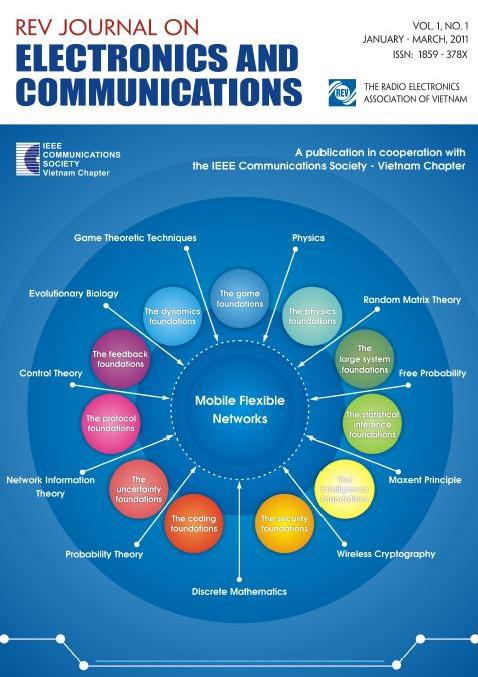
Published
2011-04-01
Section
Invited articles
An author's submission implies that the manuscript has not been published previously, and is not currently submitted for publication elsewhere. Submission also implies that the Corresponding Author has consent of all authors (the Authors). Upon acceptance for publication transfer of copyright will be made to the Publisher of REV-JEC, who guarantees that full content of the published article is freely distributed on the Journal's website. The copyright transfer gives the Publisher of REV-JEC full authority to resolve any complaints of misuse or abuse (such as infringement or plagiarism) of the published article. The Authors have the freedom to redistribute and reuse the published article in any medium or format for any purpose, provided the original published article is properly cited. An article submission implies author agreement with this policy.