An Overview of H.264 Hardware Encoder Architectures Including Low-Power Features
Abstract
H.264 is the most popular video coding standard with high potent coding performance. For its efficiency, the H.264 is expected to encode real-time and/or high-definition video. However, the H.264 standard also requires highly complex and long lasting computation. To overcome these difficulties, many efforts have been deployed to increase encoding speed. Besides, with the revolution of portable devices, multimedia chips for mobile environments are more and more developed. Thus, power-oriented design for H.264 video encoders is currently a tremendous challenge. This paper discusses these trends and presents an overview of the state of the art on power features for different H.264 hardware encoding architectures. We also propose the VENGME’s design, a particular hardware architecture of H.264 encoder that enables applying low-power techniques and developing power-aware ability. This low power encoder is a four-stage architecture with memory access reduction, in which, each module has been optimized. The actual total power consumption, estimated at Register-Transfer-Level (RTL), is only 19.1 mW.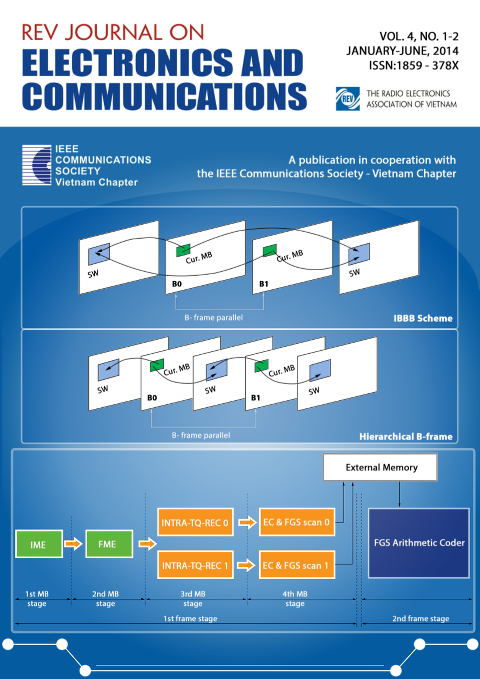
Published
2014-12-01
Section
Regular articles
An author's submission implies that the manuscript has not been published previously, and is not currently submitted for publication elsewhere. Submission also implies that the Corresponding Author has consent of all authors (the Authors). Upon acceptance for publication transfer of copyright will be made to the Publisher of REV-JEC, who guarantees that full content of the published article is freely distributed on the Journal's website. The copyright transfer gives the Publisher of REV-JEC full authority to resolve any complaints of misuse or abuse (such as infringement or plagiarism) of the published article. The Authors have the freedom to redistribute and reuse the published article in any medium or format for any purpose, provided the original published article is properly cited. An article submission implies author agreement with this policy.